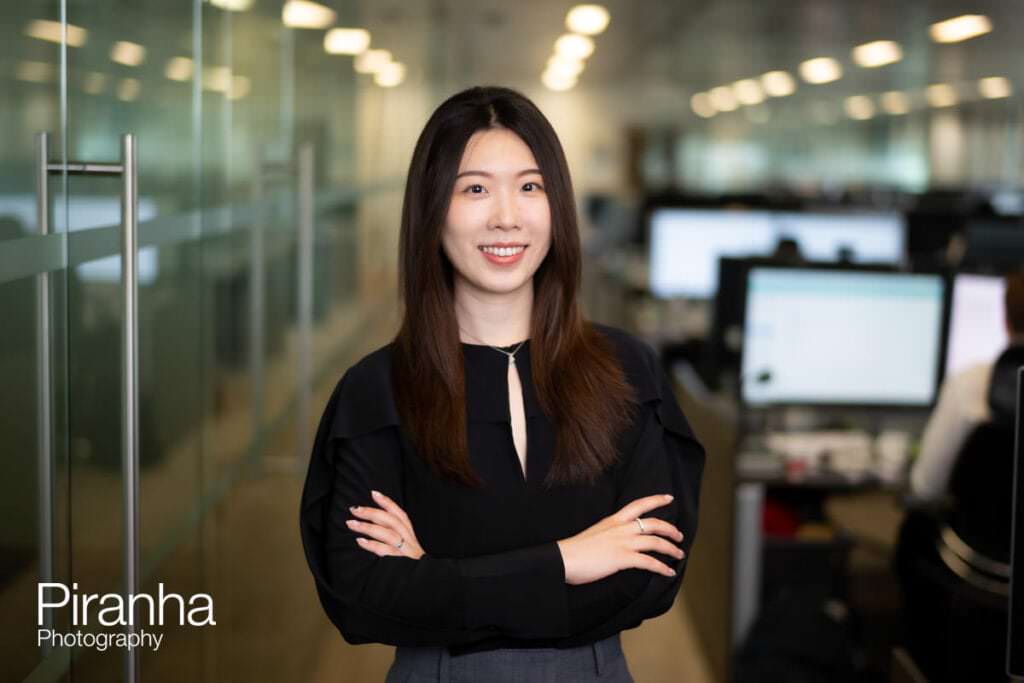
Original headshot photograph taken by Piranha Photography in client’s London offices.
Could AI Generated Images Replace Corporate Headshot Photography?
Corporate headshots are a cornerstone of Piranha Photography’s work, as they are for most professional corporate and commercial photographers.
Our job is to capture each person photographed in a series of poses (and sometimes even different outfits) which can be used for a variety of content needs including website profiles, annual reports, marketing literature and professional and personal accounts on social media platforms like LinkedIn and Instagram.
Half Day Photo Shoots or more for Major Rebrands
Taking headshots usually involves me or my colleagues spending half a day at a client’s head office, dedicating around 10 to 15 minutes to each individual being photographed.
However, if a client is undergoing a major rebranding following a merger or acquisition, or is seeking a large brand refresh for the first time in 10 years, these half-day sessions can easily extend to three or more days when the photographer has to capture a consistent set of images for an entire workforce of maybe hundreds of people. For the client, this is a significant undertaking involving both the direct costs of our fee and the indirect cost of lost productivity.
While a 15-minute session might be a minor pause for those working at the head office, it represents a substantial time commitment for regional staff, who may sacrifice an entire day’s output travelling there from distant locations.
Understandable why using AI generated images is Being Considered for Photography
It is, therefore, understandable why some organisations are turning to Artificial Intelligence (AI) to try to generate headshots. By using AI applications, they might hope to produce a uniform set of AI generated images from a single source photograph provided by each employee.
Yet, creating a uniform aesthetic where lighting and backgrounds are consistently presented is a monumental task even with AI. A marketing department attempting to process hundreds of images of colleagues would likely spend weeks on the project and quite possibly still not achieve a satisfactory set of photographs.
Management Time as well as Technical Challenges
Over and above the technical challenges of image presentation, there’s also the significant management task of asking every staff member to provide their own headshot. There will be many colleagues who respond quickly and helpfully to the request, but there will also be a significant minority of colleagues who will need repeated reminders and chasing up. There will inevitably be some who simply never bother no matter how times they are chased. In the end, if the marketing department’s time is accurately costed, collecting and processing the images could easily end up being more expensive with AI than using a professional corporate headshot photographer.
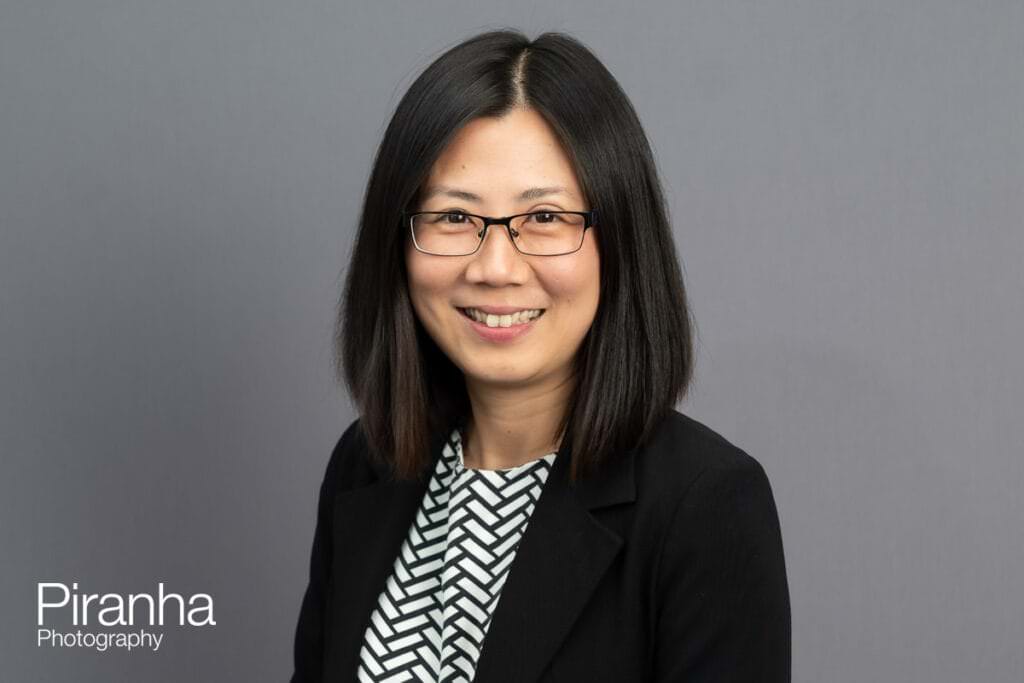
Genuine headshot photograph with grey background taken by Piranha Photography.
AI Generated looks like AI Generated
But more importantly, the images will inevitably reveal the hand of AI, which lends a dehumanising artificiality to every image it processes. The images on a cursory inspection might pass for authentic, but inevitably they won’t look quite real. Or to put it more starkly, they will look fake. In terms of mission and values, the AI headshots risk striking a discordant note, undermining brand messages of personalised service and customer care.
In the end, people relate best to people. Survey after survey tell us that customers prefer interacting with real people over a bot asking “How can I help?”
It also raises a larger question of how a company would like to present its directors and personnel on the team page of its website. Over-processed AI generated images that turn normal-looking executives into Hollywood film stars would strongly suggest vanity and insecurity rather than professional safe pairs of hands, and also risks inviting questions over their honesty and integrity.
Some post-production of images might be necessary, either to eliminate minor blemishes or unruly hair, or perhaps a reflection if someone is wearing glasses. Like a filter on a Zoom call, our standard post production option can be described as ‘imagine you have had eight hours sleep a night for a month and drank two litres of water every day’ which most clients prefer while staying well within the bounds of reality.
There are Other Factors at Stake
The rush toward AI efficiency has already seen some firms, particularly in the legal, accounting, management consultancy and tech fields reducing either graduate intake or trimming whole layers of middle management.
However, replacing human experience with algorithms is not without its pitfalls. It has been well-documented in the press that even tech giants like Google, having initially replaced experienced software engineers with AI, have had to beat a hasty retreat and resume hiring after realising that the quality of work had deteriorated.
Beyond the aesthetics of authenticity, physical photoshoots offer benefits that AI cannot replicate, such as guaranteed image security, privacy, and clear IP ownership. There are also ‘softer’ advantages. In my experience, many clients include a photography session as part of a new starter’s induction. Taking part in a corporate headshot session serves as a welcome break from intense get-up-to-speed briefings and provides a more relaxed opportunity for new recruits to bond with each other and the firm.
Losing the Personal Touch
Ultimately, it comes down to people: living, breathing, and relatable colleagues who may become friends for life. That human connection is how we measure job satisfaction, and in the end, it is what counts most, and is something we risk losing if AI generated images are used without discernment.
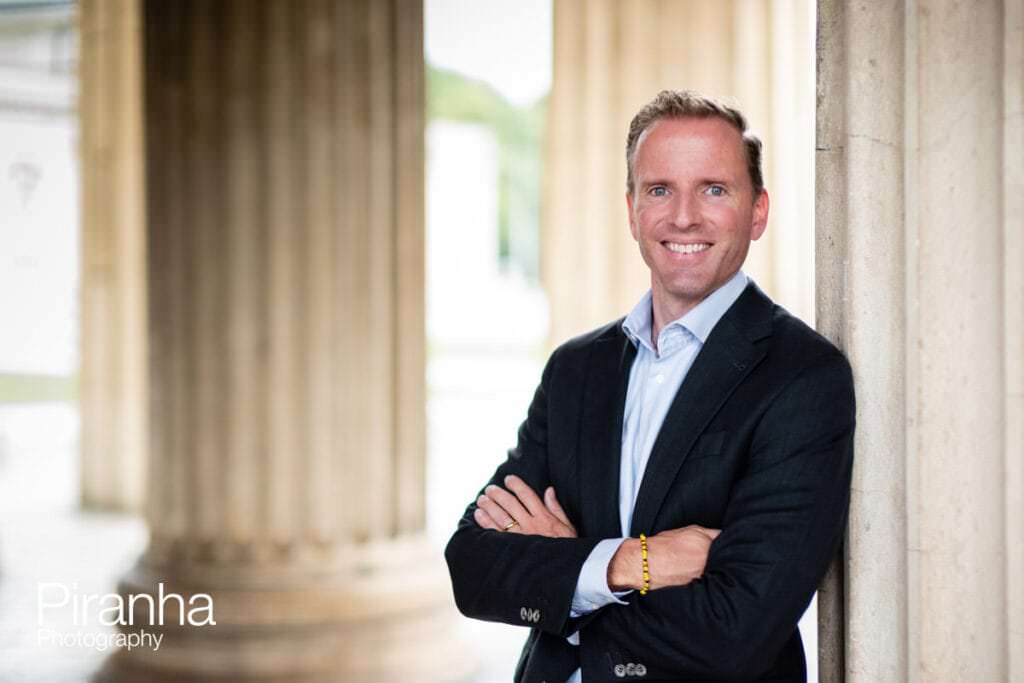
A genuine corporate headshot photograph taken by Piranha Photography on location – not AI generated.
- About the Author
- Latest Posts

Professional corporate photographer, providing company headshot photography and video for businesses in London, the rest of the UK and Europe. Piranha are commissioned by FTSE100 companies and start-ups alike, for numerous projects, covering a wide range of work and styles. Portraits and office photography for use on websites, events coverage and PR shots for press and publications, as well as Board and location photography for annual reports. Using top of the range Leica cameras and lenses. We process the images promptly and to an extremely high standard.